Is it annoying or is it criminal? The answer depends on power dynamics.
The Double Standard: How Canadian Harassment Law Protects Police From Criticism While Failing Civilian Victims
On January 23, 2026, Quebec Court Judge Guylaine Rivest found Montreal activist Yves Engler guilty of criminal harassment and obstruction of justice. His crime? Orchestrating a public email campaign from his supporters to Montreal Detective Francesca Crivello's work email, asking her to drop charges against him.
The conviction marks a troubling precedent: a detective felt "intimidated" and "frightened" by approximately 1,500 emails to her work account in a single day, and that feeling was enough to convict a private citizen of criminal harassment.
Meanwhile, across Canada, hundreds of civilians have been failed by the same criminal harassment law—victims who felt terrorized by stalking, surveillance, repeated threats, and coordinated campaigns to destroy their reputations. Yet those victims remain unprotected, their perpetrators acquitted or discharged.
The question is stark: Why does Canadian harassment law set such an impossibly high bar for protecting ordinary civilians, but such a low bar for protecting police officers?
Why This Matters to Me
I am no stranger to digital harassment. As a progressive digital campaigner and advocate, I've experienced sustained online attacks myself, and I've supported colleagues and friends through similar targeted campaigns and legal proceedings.
During 2023 and 2024, I was subjected to a harassment campaign by a man I had never met—and still haven't. I became a target because I publicly supported political candidates he disliked, promoted campaigns around queer solidarity and housing as a human right, and wrote publicly about these issues.
[TRIGGER WARNING for graphic violent and sexual language]
This man created several fake profiles using my name and face to impersonate me and harass me directly. What followed was relentless: on some days, over a hundred messages. The content was graphic and disturbing—he posted vivid descriptions of sexual assault, murder, ways I could be skinned alive, set on fire, dismembered. When I posted a cute photo of my cat, his fake accounts hypothesized about skinning my cat and stapling his skin back on inside out before setting him on fire.
He used the fake profiles with my name and face to say these things to other people in an attempt to damage my reputation and encourage them to report "me" to police for what I allegedly said. He created fake emails using my friends' names and sent me long, abusive rants. Using a form on my employer's website, he emailed them pretending to be me, saying all manner of horrible things.
I eventually reported it to the police and was assigned a detective. I assembled detailed evidence and documentation. But nothing reached the threshold of actionable criminal harassment under Section 264 according to the detective. In our discussions the detective stated that because these messages discussed graphic hypotheticals but did not include explicit threats to do these things to me, they fell short of what the law recognizes as harassment. The kicker is: I did not even want to press charges yet, I just wanted the behaviour to stop and protect myself. It took over a month for the detective to even call my harasser and issue a warning.
In Engler’s case, he was arrested the next day. You don’t have to like Engler’s actions, or his viewpoints, but we must consistently make a distinction between behaviour we don’t like and criminal behaviour. Justice in these cases is predicated on proximity to power rather than the facts.
And it isn’t new. Ten years ago I was tangentially involved in the first major Twitter harassment case in Canadian courts in 2016—R v Elliott, which resulted in acquittal despite years of sustained abuse—the gap between what the law protects and what victims experience has only widened. Yet when police officers themselves become the targets of public campaigns, the bar for conviction drops dramatically.
What Makes Harassment Criminal?
Before examining how the law is being applied, it helps to understand what it actually requires.
Canada's Criminal Code Section 264 (Criminal Harassment) requires the Crown to prove all of the following:
Repeated conduct against a person
The person knew or was reckless about whether the conduct constituted harassment
The person engaged in this conduct knowing it was harassment, OR the conduct caused the victim to reasonably fear for their safety
The fear was reasonable in all the circumstances
The final element—"reasonable fear"—is the critical phrase that has become the legal battleground. It's where civilian victims lose their cases and where the Engler precedent becomes so dangerous.
The Engler Case: What Happened
Yves Engler is a Montreal-based writer, activist, and self-described "agitator" known for public criticism of Canadian foreign policy, particularly regarding Israel-Palestine and Haiti. In February 2025, he was accused of harassing Dahlia Kurtz, a Toronto-based social media influencer, through interactions on X (formerly Twitter).
On February 18, 2025, Detective Francesca Crivello (Montreal Police, Hate Crimes Unit) phoned Engler to inform him he would be arrested on harassment charges related to the Kurtz complaint.
That same day, Engler published a blog post on his website describing the charges as "an abuse of state power." The post included a form letter template and an embedded direct link to Det. Crivello's work email address, inviting supporters to email her and call for the charges to be dropped.
The form in question was distributed by ActionKit, a standard tool used by many campaigners and organizers to run public accountability campaigns—typically targeting political representatives on issues like climate action, labor rights, or other matters of public concern.
The Email Campaign
The following day, February 19, 2025:
Det. Crivello received approximately 1,500 emails in her work inbox within a few hours
Most emails used the same subject line: "Drop the charges against Yves Engler"
The campaign continued throughout the day, temporarily disrupting her email functionality
A Montreal police cybersecurity specialist was forced to block the email domain responsible for most of the flood
The Police Response
Rather than treating this as a public petition campaign—a standard form of democratic advocacy—Montreal Police:
Charged Engler with harassment and obstruction of justice based on organizing the email campaign
Arrested him the next morning (February 20)
Held him in custody overnight
Initially imposed bail conditions preventing him from discussing the case publicly—a condition Engler's lawyer argued as a violation of his Charter-protected freedom of expression
Added additional charges when Engler published about the arrest
The Trial & Conviction
At trial in November 2025, Detective Crivello testified:
"I was still working on my investigation. I found myself wondering, 'What awaits me next?' What comes after this? I was personally targeted. It wasn't an attack on the Service de police de la Ville de Montréal. I am not a public figure; I am an investigator. I felt personally intimidated. My work was obstructed. I even felt frightened."
Judge Rivest accepted this testimony and found:
"[Engler] was aware that he had a significant following on all his social media platforms. He understood that his call to action would be heeded by many due to his prominence online. He intended to obstruct the peace officer's work through the influx of emails related to the charges he faced, or at the very least, he could have anticipated this outcome with a high degree of certainty."
Verdict: GUILTY on all three counts (harassment, obstruction of justice, and a related charge).
Sentencing is set for March 2026.
What Made Engler's Case Different
Notably, the judge's reasoning focused on factors that would NOT typically be required in other cases:
His prominence/platform: His social media following meant his call to action would be "heeded by many"
His knowledge of impact: He "understood" and "anticipated with high degree of certainty" that supporters would respond
His intent to obstruct: Whether deliberate obstruction or foreseeable consequence, the impact on the investigation mattered
The police officer's subjective feeling: She "felt personally intimidated" and "frightened"—and that feeling was sufficient for conviction
Compare this to the standard Section 264 requires: proving that the victim had a "reasonable fear for safety." In Engler's case, the conviction rested on an officer's administrative inconvenience and emotional discomfort—not fear for physical safety.
Why This Sets a Dangerous Precedent
The Engler conviction establishes a dangerous new precedent: political speech can now be criminalized as harassment if:
You have a public platform
You call on supporters to contact a government official (including police)
That official feels intimidated by the volume of communication
You foresaw or should have foreseen that your supporters would respond
This has profound implications. Advocacy campaigns targeting police accountability, Crown prosecutors, or state officials—standard democratic practice—now risk criminal charges. The tool intended to protect victims from stalking has been repurposed to protect authorities from public pressure.
As a digital campaigner and activist, this precedent terrifies me. It means that organizing public campaigns around police accountability, calling for prosecutorial review, or mobilizing supporters to contact state actors is now potentially a criminal offense.
It’s worth noting that I don’t like Yves Engler, a lot of people don’t like Engler. But I recognize the difference between dislike and criminal behaviour, and more importantly, I recognize the behaviour of institutions deliberately choosing unpopular causes or people to test the elasticity of the law in their favour.
A Critical Contrast: R v Elliott (2016)
To understand how unprecedented the Engler conviction is, consider the Elliott case—the first major Twitter harassment trial in Canadian courts.
Toronto artist Gregory Alan Elliott was acquitted in 2016 despite what many considered sustained digital harassment of two feminist activists. I sat in that Toronto courtroom in 2016, and I watched as the judge spent three hours explaining why he had to acquit despite finding the conduct was indeed harassment.
Over a three-year period, Elliott sent hundreds of tweets, used offensive and vulgar language, and persisted in tagging the women even after they blocked him. The women testified they felt monitored and tracked.
The judge acknowledged the conduct was "harassment" but found it did NOT meet the criminal threshold because:
The tweets contained no sexual or violent threats
The judge deemed the victims' fear stemming from "perception," not reasonably justified
Elliott's "stubbornness" was "childish" but not criminal
Yet by contrast, Detective Crivello's receipt of 1,500 petition emails—with no personal threats, no harassment of her personally, organized through standard advocacy tools—was deemed sufficient for criminal harassment conviction.
The women in the Elliott case felt their lives were being monitored over three years. The detective in the Engler case received emails for one day. One was acquitted. One was convicted.
Other Cases That Met the Bar: What It Actually Takes
If civilian harassment requires such an impossibly high bar, what evidence is necessary for conviction?
2017 BCSC 2361: The Mr. F Case
During an acrimonious custody battle, Ms. C's ex-partner, Mr. F (an IT professional), launched an 18-month campaign of terror:
Created a website registered under Ms. C's full name, publishing:
Private photos of her, her children, friends, and family
Her residential address and contact information
False allegations she was a "white supremacist," "sociopath," and "unfit mother"
Private email communications obtained without consent
A fake blog written in her voice describing her as a "terrible person"
Sent the website link to her colleagues at work (public humiliation)
Threatened to hire someone to obtain intimate photos and post them online
Sent hundreds to thousands of emails explicitly designed to "destroy you—slowly and incrementally"
Attempted to alienate her child from her by copying their son on harassing emails
Made explicit threats about obtaining firearms to harm her across the U.S. border
Was caught shipping firearms to the United States (where she lived)
Kept her in "perpetual fear of new ways he would devise to torment her"
The court noted:
"The harassment was particularly insidious because [Mr. F] kept [Ms. C] in perpetual fear of new ways he would devise to torment her. Mr. F's professional expertise is in information technology, and he appeared to [Ms. C] to have an alarming ability to gain access to confidential information about her and the people in her life."
Outcome: CONVICTED (jury trial)
Sentence: 3 years 10 months imprisonment
3 years probation
Lifetime firearms prohibition
No-contact order
Post-release internet prohibitions
2015 BCPC 203: The Mr. B Case
Mr. B was a 17-year-old who orchestrated repeated "doxing" and targeted harassment campaigns that included:
23+ victims (mostly young women)
Sophisticated doxing (social engineering to extract addresses from Amazon and Rogers)
Swatting (false 9-1-1 calls, bomb threats, emergency response to homes)
Multiple coordinated platforms (9-1-1, phones, internet, social media)
Pre-sentencing report documenting misogynistic motivation (victims "quite disproportionately female")
One victim, after Mr. B posed as an Amazon employee to obtain her information, received a police and bomb squad response to her home—all based on a false report he made.
Outcome: GUILTY PLEA to 23 of 48 counts
Sentence: 16 months imprisonment
8 months community supervision
Complete technology ban with warrantless police search authority
Court found he posed "high risk for future internet-based offences"
In both of these cases required a high threshold for continued pain, harm, and the behaviour spread before it was addressed. This effectively creates a system where civilians–with less access to power and safety than police personnel–are required to endure prolonged and egregious harm to seek justice.
The Power Dynamics: Why Police Get Special Protection
Detective Crivello testified:
"I am not a public figure; I am an investigator."
But this is precisely the problem. She has:
State authority (she can arrest people)
Weapons (she carries a gun)
Institutional backing (she works for police service that can retaliate)
Legal resources (Crown prosecutors working on her behalf)
Ability to investigate/charge (she can use state power to escalate against someone who organizes public criticism)
Civilians in harassment cases have:
No authority
No weapons
No institutional backing
Private lawyer resources (if they can afford them)
No ability to escalate beyond police (who may dismiss them)
The Structural Inequality
When police prosecute harassment against themselves:
They control the investigation
They decide whether to lay charges
They testify as the victim
They work with Crown prosecutors daily
They have credibility built into the system
They can add additional charges if criticized
When civilians are victims of harassment:
Police decide whether to investigate (and often don't)
Police decide whether to lay charges (and often don't)
Victims must navigate courts without institutional backing
Victims must prove "reasonable fear" that courts deem trivial
Victims cannot escalate through state machinery
This structural inequality is not accidental. The 1996 Department of Justice comprehensive review of Section 264 found that 58% of criminal harassment charges were withdrawn or stayed—compared to only 26% of federal/provincial charges generally.
This suggests systemic underenforcement when ordinary civilians are victims, but rapid prosecution when state actors are targeted.
Regional disparities in enforcement are also telling:
Vancouver & Edmonton: 28% and 26% of cases fully dropped (highest dismissal rate)
Toronto & Montreal: 16% and 19% dropped
Halifax: Only 10% dropped
This inconsistency suggests that harassment law is applied arbitrarily, based partly on whether police are motivated to investigate and partly on Crown discretion.
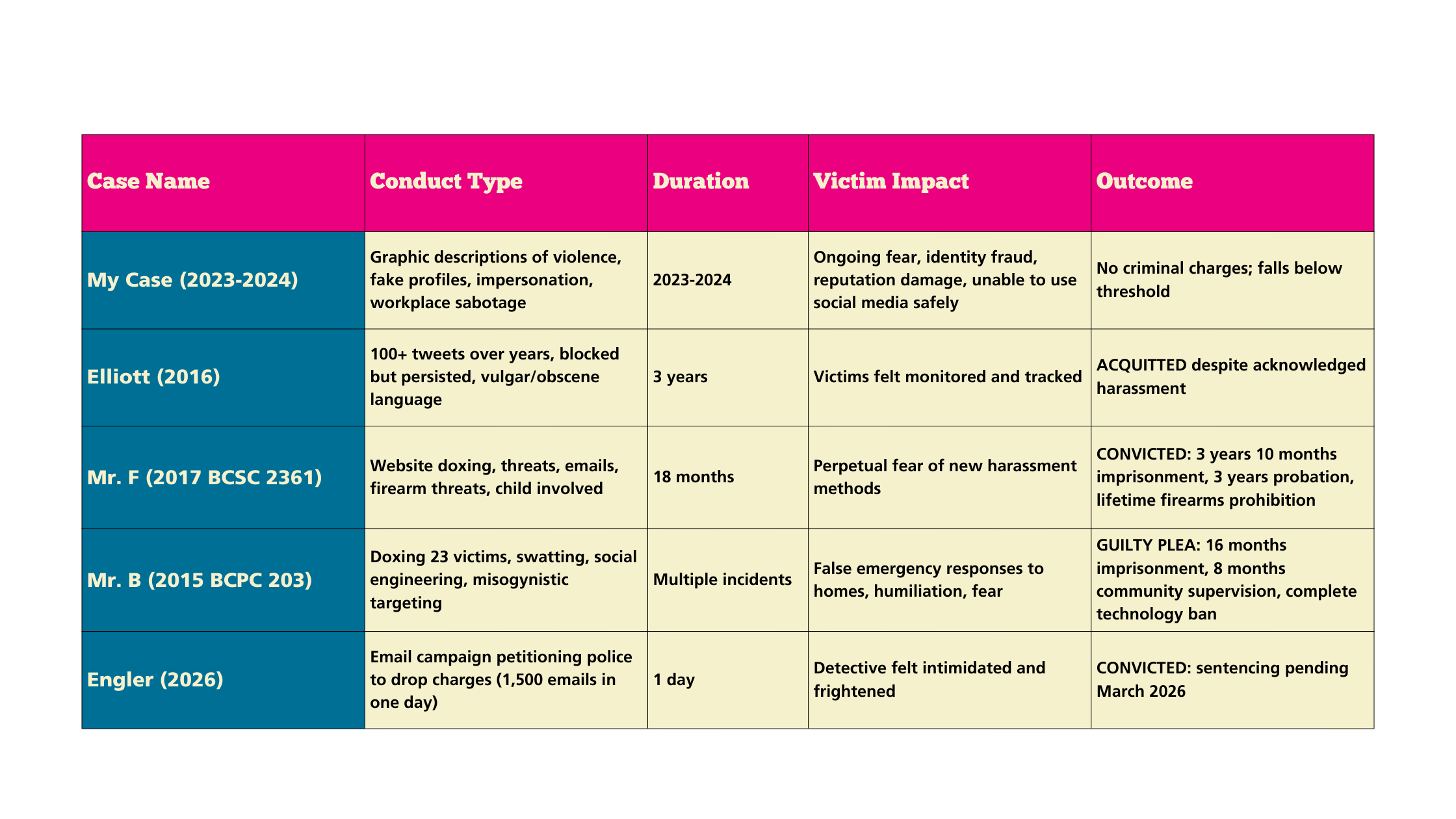
A case by case comparison of harassment cases.
Why I Wrote This
In 2016, I sat in a Toronto courtroom holding a friend's hand through the R v Elliott decision as the judge spent three hours explaining why he had to acquit despite finding the conduct was indeed harassment. The sentencing hearing began with an incomplete description of how Twitter and hashtags work. The case had taken three years to reach verdict, and it garnered international attention that brought alt-right activists and men's rights supporters into the courtroom to support a man's "right to free speech"—even though the judge acknowledged that speech was "childish, vulgar, and obscene."
Warning people about how dangerous this precedent was felt like trying to nail jello to a tree; fruitless, messy, and frustrating.
And yet, we find ourselves at a point where doxing civilians, creating nonconsensual pornography, and coordinated harassment campaigns are rampant. The tools have gotten more sophisticated. The campaigns have gotten more coordinated. And the law has not caught up—except to use it against activists.
Ten years later, I'm sitting here, feeling that same sense of dread, seeing the writing on the wall in terms of how digital activism will be punished and policed. The Engler conviction isn't an aberration. It's the natural extension of a legal framework designed to protect powerful institutions from criticism while failing ordinary people who need actual protection.
I hope in 2036 I can sit here and feel proven wrong.
Because a democracy in which police can use criminal law to suppress public criticism while leaving civilians vulnerable to real harassment is not a democracy at all. It's the weaponization of state power against dissent.
Resources & Citations
Legal Sources
Section 264 Criminal Code (Criminal Harassment)
1996 Department of Justice Criminal Harassment Review
Comprehensive analysis of 601 cases across Canada
Available:
https://www.justice.gc.ca/eng/rp-pr/cj-jp/fv-vf/wd96_7-dt96_7/
This review documents the systemic dismissal rates and includes detailed victim case studies
Case Law
R v Elliott (2016)
Citation: 2016 ONCJ 35
First major Twitter harassment trial in Canadian courts; resulting acquittal despite acknowledged harassment
2017 BCSC 2361 (Mr. F Case)
British Columbia Superior Court decision
Case involves website doxing, thousands of harassing emails, and cross-border firearm threats
Resource: Equality Project,
2015 BCPC 203 (Mr. B Case)
British Columbia Provincial Court decision
Involves doxing and swatting of 23+ victims; resulted in guilty plea to 23 of 48 counts
Resource: Equality Project,
Recent Engler Conviction Coverage
Montreal Gazette (January 23, 2026)
"Self-described 'agitator' found guilty of harassing Montreal police officer"
The Globe and Mail (January 23, 2026)
"Yves Engler found guilty of harassment over mass e-mail campaign"
JURIST – Canada Dispatch (January 24, 2026)
Analysis of the Engler conviction in legal context
Advocacy Resources on Harassment Law
Equality Project: Criminal Harassment Case Law
Comprehensive resource documenting harassment convictions, acquittals, and case law across Canada
https://www.equalityproject.ca/resources/tfv-criminal-case-law/
LEAF (Women's Legal Education and Action Fund)
Resources on tech-facilitated violence and harassment law
Kathy Grant's Work on Canadian Harassment Law
Academic analysis of gaps in Section 264 protection
Outside of the Shadows: