5 Campaign Wins to Celebrate This St Patrick’s Day
St Patrick’s Day is often wrapped in green hats and parades, but it is also a moment to remember something deeper: the Irish Republic’s long tradition of ordinary people organising for extraordinary justice. From workers on picket lines to young people running social media war‑rooms, Irish campaigns have punched far above their weight in global struggles for dignity, equality and human rights.
For those of us in the social impact sector, these stories are more than history; they are a reminder of why we do this work, and how powerful community‑driven organising – amplified by digital tools – can be.
Today, I’m celebrating five campaign wins that show Ireland at its best.
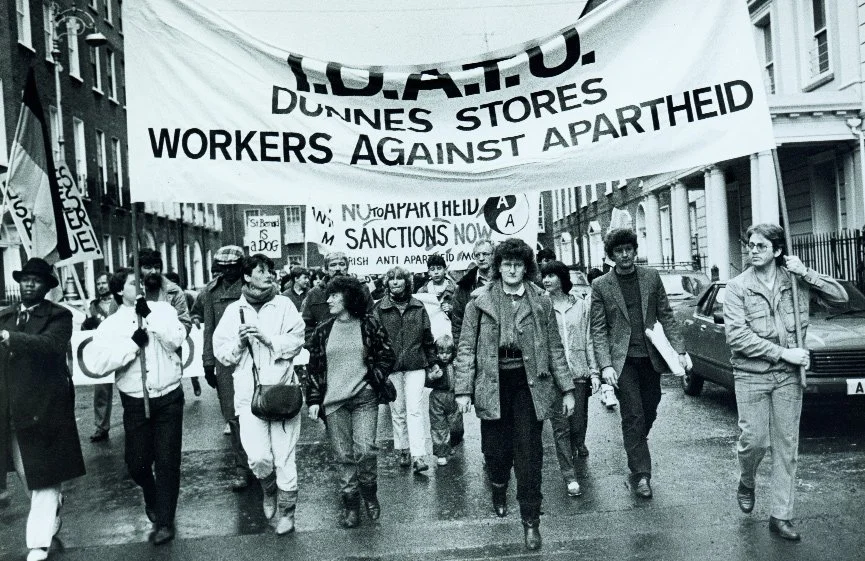
Dunnes Stores strikers on an Irish Anti-Apartheid Movement national march through Dublin, November 1986. (An Phoblacht)
1. Standing Up to Apartheid: The Irish Anti‑Apartheid Movement
Long before hashtags and livestreams, the Irish Anti‑Apartheid Movement (IAAM) helped turn public conscience into political pressure. Founded in 1964, IAAM educated the Irish public about apartheid, supported political prisoners in South Africa, and campaigned for a boycott of South African goods.
A defining moment came in the mid‑1980s when a group of mainly young workers at Dunnes Stores in Dublin refused to handle South African produce, sparking a strike that lasted nearly three years. Their stand helped push Ireland to ban South African goods in 1987, making it one of the first countries to take such a strong stance.
The IAAM and the Dunnes strikers remind us that structural change often begins with a small group of people willing to say “no” – and invite the world to stand beside them.
2. Love Wins: Yes Equality and the Marriage Referendum
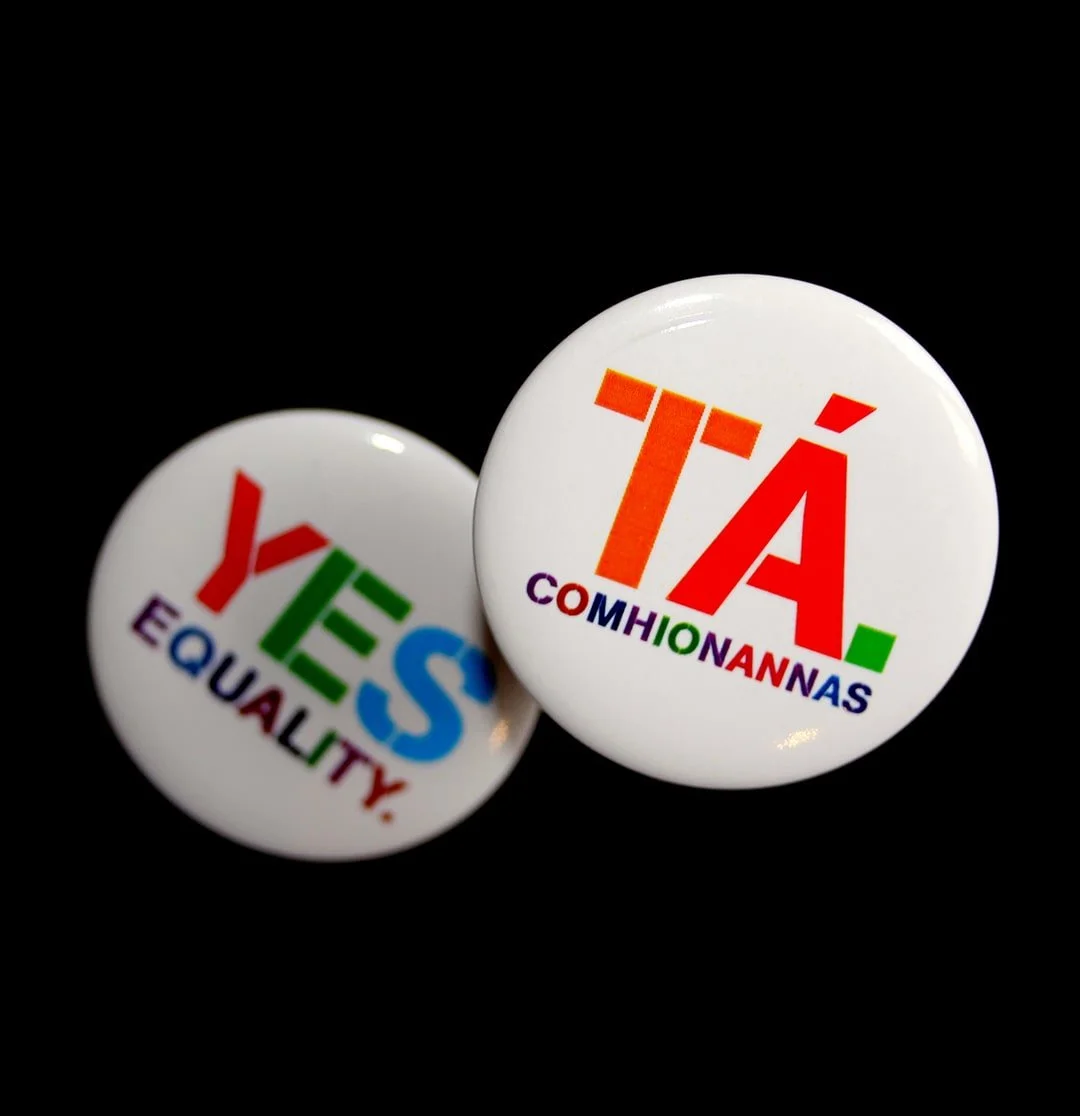
Yes Equality
‘This campaign would create an identity in which everyone could see themselves and the values they would be happy to stand up and vote for.’
Ireland Says Yes: Gráinne Healy, Brian Sheehan and Noel Whelan
Fast‑forward to May 2015, when Ireland became the first country in the world to introduce marriage equality by popular vote. The Yes Equality campaign turned what could have been a technocratic constitutional amendment into a national conversation grounded in love, dignity and belonging.
Described as the most extensive civic campaign in Irish political history, Yes Equality put digital tools at the centre of its strategy. organizers used social media avatars, shareable graphics and personal video stories to make support visible and contagious, inviting people to “come out” not only as LGBTQ+ but as allies, parents, neighbours and colleagues.
A clear ladder of engagement emerged: small online actions (changing a profile picture, sharing a story) led to bigger commitments (donating online, joining local canvass groups, hosting conversations at work or in community halls). Digital messaging turned TV debate moments into mobilisation calls: “Don’t just get angry – join your local canvass.”
For those who build social impact campaigns, Yes Equality proves that when we combine data‑informed digital outreach with heartfelt storytelling and strong local organising, we can transform public attitudes and secure lasting constitutional change.
3. Bodily Autonomy and Digital Feminism: Repeal the 8th
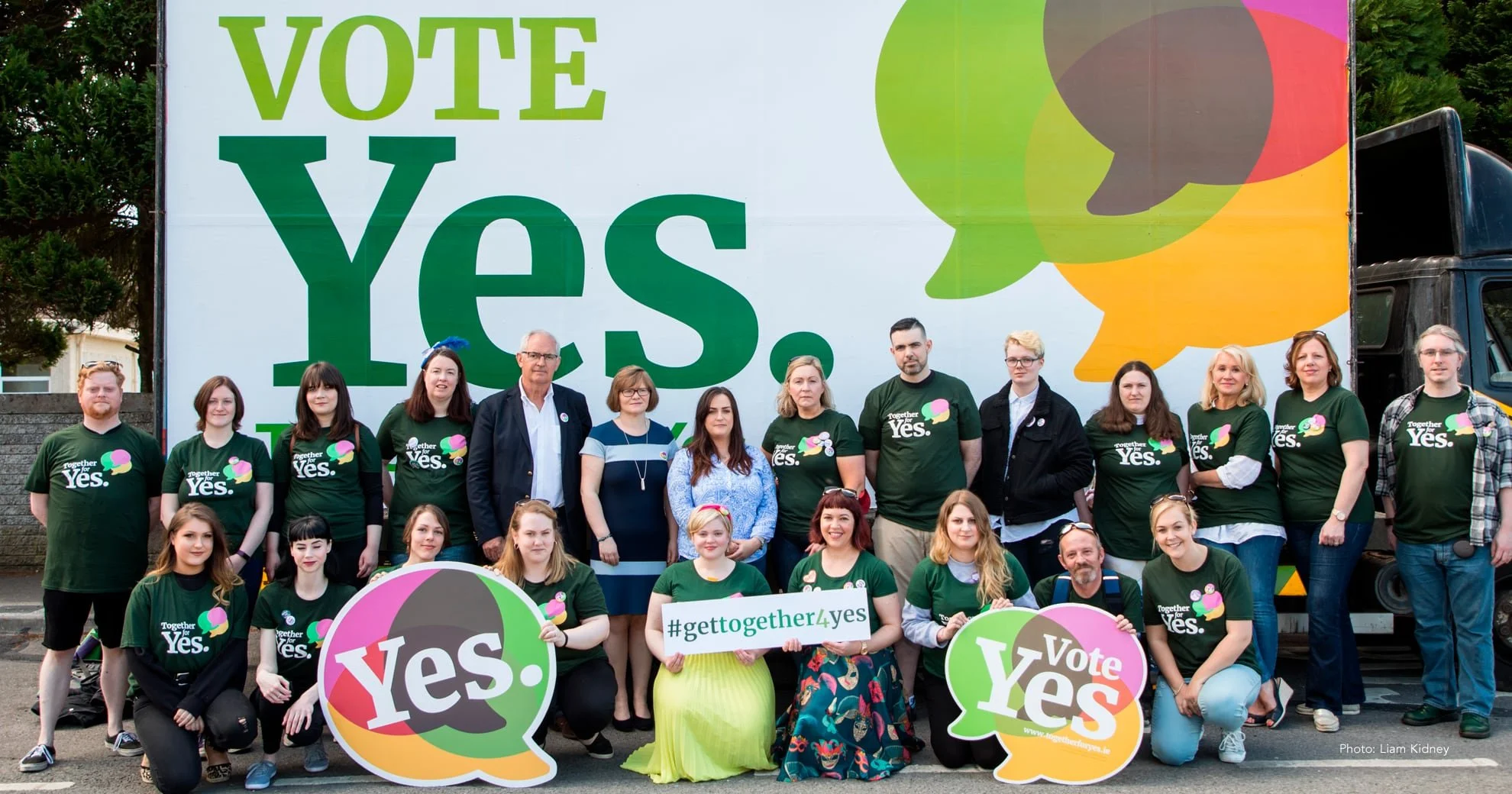
Organizers of the Together for Yes coalition.
Three years later, Ireland faced another defining vote: whether to repeal the Eighth Amendment and allow abortion access in Irish law. In May 2018, a clear majority voted Yes, following an intense campaign led by the Together for Yes coalition and the broader #RepealThe8th movement.
Online, #RepealThe8th became a powerful community space, the top trending political hashtag in Ireland that year. Activists used digital platforms to share personal stories, challenge stigma and reframe what it meant to be “a good Irish person” – not as silent and obedient, but as compassionate, feminist and committed to healthcare rights.
Together for Yes ran a sophisticated digital‑plus‑grassroots operation: data‑driven canvassing tools, platforms to connect volunteers to local canvass teams, and targeted social content that moved people from information to persuasion to turnout.
For social impact professionals, Repeal offers a masterclass in digital storytelling, intersectional framing and community‑based data use. It shows how online spaces can hold grief, anger and hope – and then channel them into doorsteps, polling stations and ultimately, legislative change.
4. Global Solidarity, Local Streets: Ireland–Palestine Campaigns
In recent years, Ireland has become one of the loudest European voices for Palestinian rights, with the Ireland‑Palestine Solidarity Campaign (IPSC) and allied groups at the forefront. A volunteer‑run organisation, IPSC campaigns for freedom, justice and equality for Palestinians, including boycotts, divestment and sanctions.
Digital platforms act as hubs for mobilisation. IPSC and local groups use X/Twitter, Facebook and Instagram to call protests, share testimonies from Gaza and the West Bank, and link small rural communities – and even offshore islands – into a national movement. Voices often draw on parallels between Irish histories of colonisation and contemporary struggles in Palestine, and the responsibility to stand with oppressed peoples.
The result is a powerful loop: online content inspires people to join marches, lobby public representatives, push for municipal BDS motions, and support legal and diplomatic initiatives – and those street scenes then flow back into digital space as images of mass solidarity.
Irish‑Palestinian solidarity campaigns underscore how digital media can nurture long‑term commitment in the face of slow or contested “wins,” and how storytelling across borders can deepen our understanding of justice at home.
5. Water Is a Right: The Right2Water Movement
Not all historic wins come wrapped in referendums. The Right2Water campaign, launched in 2014 by trade unions, progressive parties and community groups, mobilised hundreds of thousands of people against new domestic water charges that would have hit low‑income households hardest.
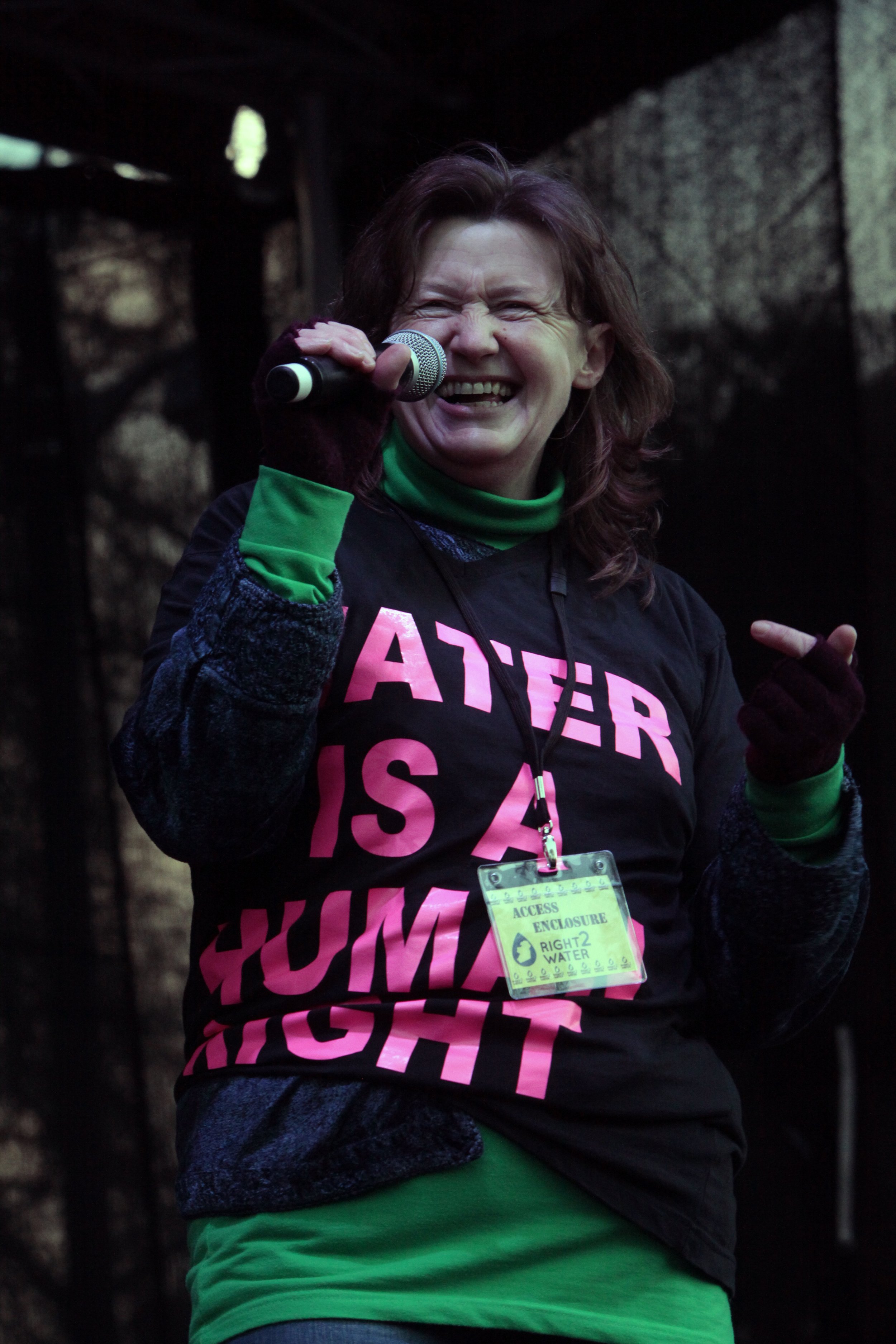
Right2Water Organizer In Action
Organizers used social media, online petitions and local Facebook groups to coordinate protests, share legal information, and debunk myths. Photos and videos of huge demonstrations, clever homemade placards and community meetings spread quickly, helping people in small towns see that they were part of something much larger.
The campaign ultimately forced the government to abandon its plans for full water charges, a major victory for working‑class households and for the idea that essential services should not depend on ability to pay.
Right2Water is a reminder that digital tools can energize everyday people around “bread and butter” issues – and that defending public goods is as much a justice struggle as passing new rights.
Why These Stories Matter for Our Work
Taken together, these five campaigns sketch a distinct Irish tradition of civic power:
A belief that ordinary people, organized together, can challenge global injustice (IAAM, IPSC).
A deep commitment to personal dignity and equality in law and everyday life (Yes Equality, Repeal).
A refusal to accept that basic needs like water are just another bill, rather than a shared right.
What has changed over time is not the core values, but the tools. Where IAAM relied on newsletters, public meetings and traditional media, today’s movements harness digital storytelling, data‑driven outreach, and online communities to accelerate what Irish activists have always done: build solidarity, shift narratives, and win concrete change.
For those of us working in social impact – whether in NGOs, community groups, philanthropy or public service – these campaigns are both a legacy and a challenge. They ask us to use our skills, platforms and technologies in the service of people whose voices are too often ignored, and to remember that the point of the work is not metrics on a dashboard, but lives changed, rights secured and futures opened.
This St Patrick’s Day, as we wear green and share stories, we can also recommit ourselves to that tradition: to building campaigns that are rooted in community, powered by solidarity, and amplified by digital tools – so that in ten or twenty years’ time, new generations will be celebrating the wins we are working toward today.
Further Reading
Irish Anti‑Apartheid Movement & Dunnes Stores Strike
RTÉ Archives – “Irish Anti‑Apartheid Movement 50 Years Old, 1978”
History Ireland – “An ‘boks amach’: the Irish Anti‑Apartheid Movement”
The Irish Times – “How 11 striking Irish workers helped to fight apartheid”
The Diplomatic Society – “Celebrating Ireland’s Shared History with South Africa”
Yes Equality / Marriage Equality
Campaigns & Elections – “Digital Lessons from the Most Extensive Civic Campaign in the History of Irish Politics”
Repeal the 8th / Together for Yes
UCD – “Repealthe8th: Online Activism’s Impact on the Referendum”
Interface Journal – “Discourse and power in Ireland’s Repeal the 8th movement” (McKimmons & Caffrey)
National Women’s Council – “Learning from the 2018 Together for Yes campaign”
Ireland–Palestine Solidarity
Al Jazeera / The Stream – “Understanding Ireland’s solidarity with Palestine”
No Way to Treat a Child – “Understanding Irish–Palestinian Solidarity”
Right2Water / Water Charges
Mandate Trade Union – “Right2Water Right2Change”
Rupture – “Ireland’s Water War”
Digital Rights Ireland – “Remembering the Protest Against Water Charges in Ireland 10 Years On”